How to Make a Chipotle Bowl at Home, With Chipotle Own Portions
Most guides to building a Chipotle bowl at home give you five component recipes and leave you to guess the quantities. Chipotle publishes its portion weights — they are embedded in its nutrition data — and it builds in a fixed order for reasons that have nothing to do with tradition. This page gives you both, plus the comparison nobody makes: what a homemade bowl actually works out at against a real Chipotle bowl, using Chipotle own published numbers.
⬇️ Jump straight to the recipe

Chipotle portions are 4 oz each of rice, beans and protein, 4 oz chunky salsa or 2 fl oz tomatillo salsa, 1 oz cheese, 2 oz soured cream and 4 oz guacamole. Build in Chipotle order: rice, beans, protein, salsas, cheese and cream, lettuce, guacamole on top. One cooking session of all the components makes six bowls.
- Chipotle portion weights are published. 4 oz rice, beans and protein.
- Build order: rice, beans, protein, salsa, dairy, lettuce, guac.
- One session makes six bowls — about $64.50 of Chipotle.
- A homemade bowl saves roughly 680mg of sodium on a like-for-like build.
- Never store an assembled bowl. Components separately, always.
- Guacamole is free on a veggie or sofritas build at Chipotle.
Chipotle Own Portion Weights
Nobody writing about this converts a Chipotle bowl into quantities, and the information has been sitting in Chipotle nutrition data the whole time — every published calorie figure comes with the serving size it applies to.
| Component | Chipotle portion | Calories | Sodium |
|---|---|---|---|
| Cilantro-lime white rice | 4 oz | 210 | 350 mg |
| Cilantro-lime brown rice | 4 oz | 210 | 190 mg |
| Black or pinto beans | 4 oz | 130 | 210 mg |
| Chicken | 4 oz | 180 | 310 mg |
| Steak | 4 oz | 150 | 330 mg |
| Barbacoa | 4 oz | 170 | 530 mg |
| Carnitas | 4 oz | 210 | 450 mg |
| Sofritas | 4 oz | 150 | 560 mg |
| Fresh tomato or corn salsa | 4 oz | 25 / 80 | 550 / 330 mg |
| Tomatillo salsas | 2 fl oz | 15 / 30 | 260 / 500 mg |
| Cheese | 1 oz | 110 | 190 mg |
| Soured cream | 2 oz | 110 | 30 mg |
| Guacamole | 4 oz | 230 | 370 mg |
| Fajita vegetables | 2 oz | 20 | 150 mg |
| Romaine lettuce | 1 oz | 5 | 0 mg |
Chipotle own caveat applies, and it is worth quoting: serving sizes are approximations only based on how menu items are usually prepared and may vary from order to order.
Ingredients
Make these (each links to the full recipe)
- Cilantro-lime rice – one batch, six 4 oz scoops
- Black beans – one batch, four 4 oz scoops
- Chicken, steak, barbacoa, carnitas or sofritas – one batch
- Fresh tomato salsa and/or corn salsa – one batch each
- Guacamole – one batch, made the day you eat it
Buy these
- 6 oz (170 g) Monterey Jack, grated – 1 oz per bowl
- 12 oz (340 g) soured cream – 2 oz per bowl
- 1 romaine lettuce, shredded
- 2 limes, cut into wedges
Instructions
- Make the adobo paste first. It is the base of the chicken, the steak, the sofritas and the vinaigrette, it takes about 40 minutes, and one batch covers four pounds of meat. Do this the day before everything else.
- Get the protein marinating or braising. Marinades need 2 to 8 hours; braises need 3 1/2 to 4. Whichever you chose, it starts before anything else on the day.
- Beans next, then rice. The beans take about 25 minutes and hold happily. The rice needs to be last of the hot components, because it is the one that suffers most from sitting.
- Salsas while the rice rests. Both chunky salsas are knife work and no cooking, so they fit into the 10 minutes the rice is resting off the heat.
- Guacamole last, and only for today. It browns. Make a batch for the bowls you are eating now, not for the week.
- Build in Chipotle order. Rice, then beans, then protein, then salsas, then cheese and soured cream, then lettuce, then guacamole on top. The order is not arbitrary – see the section below.
Recipe Notes
- CHIPOTLE PORTION WEIGHTS, from its own published nutrition data: 4 oz rice, 4 oz beans, 4 oz protein, 4 oz for the chunky salsas and 2 fl oz for the tomatillo ones, 1 oz cheese, 2 oz soured cream, 4 oz guacamole, 1 oz romaine. Weigh them once and you will never need to again.
- One session of all the components makes SIX BOWLS. At the $10.75 a chicken bowl typically costs, six bowls at Chipotle is about $64.50 – which is the number to hold your shopping receipt against.
- Store every component separately and never assemble a bowl you are not about to eat. Assembled bowls go soggy within hours.
- Keeping times: protein 4 days, rice 4 days, beans 4 days, chunky salsas 2 to 4 days, guacamole 1 day. Freeze protein, rice and beans for 3 months; never freeze the salsas or the guacamole.
- Reheat only the rice, beans and protein – 60 to 90 seconds in a microwave with a splash of water – and add the cold components afterwards. That is also how a restaurant bowl works.
Estimated Nutrition
Calculated estimate for one serving of this home recipe, not a Chipotle figure. It will shift with your brands, cuts and portioning.
The Build Order, and Why It Matters
Chipotle assembles in a fixed sequence, and it is not arbitrary. Working from the bottom up:
| Layer | Component | Why it sits there |
|---|---|---|
| 1 | Rice | Absorbs the juices from everything above it. This is the whole reason it goes first |
| 2 | Beans | Their liquid soaks down into the rice rather than pooling |
| 3 | Protein | Hot, in the middle, where its warmth reaches both directions |
| 4 | Salsas | Sit on the protein so the heat lifts their aroma |
| 5 | Cheese and soured cream | On top of the heat, so the cheese softens and the cream loosens |
| 6 | Lettuce | Above the heat, so it stays crisp instead of wilting |
| 7 | Guacamole | Last and on top, where it stays cool and does not brown against hot rice |
Two of those are worth copying deliberately at home. Cheese goes directly onto the hot protein, because that is what makes it melt — put it on top of cold guacamole and it just sits there in strands. And guacamole goes on last, because avocado against hot rice browns and warms within minutes.
The Cooking Order
Five components with wildly different timings, so the sequence matters as much as the recipes.
| When | What | Time |
|---|---|---|
| Day before | Adobo paste | 40 min, and it keeps 2 weeks |
| Day before, or 2-8 hr ahead | Marinate the chicken or steak | 15 min of work |
| 4 hr before | Start a braise if you chose barbacoa or carnitas | 3 1/2 – 4 hr, unattended |
| 1 hr before | Beans | 25 min, then they hold |
| 35 min before | Rice | 20 min plus a 10 min rest |
| While the rice rests | Salsas | 10-15 min, no cooking |
| 20 min before | Sear the marinated protein | 12-16 min plus a 10 min rest |
| Last | Guacamole | 10 min. Make it for today only |
The adobo paste is the real unlock. It is the base of the chicken, the steak, the sofritas and the vinaigrette, one batch covers four pounds of meat, and making it the day before turns the whole project from four hours into about ninety minutes of work.
Homemade vs a Real Chipotle Bowl
This comparison does not exist anywhere else, and it is the obvious question. Both columns are built by adding up Chipotle own published per-item figures rather than estimating.
A loaded chicken bowl, at Chipotle
White rice, black beans, chicken, fresh tomato salsa, corn salsa, cheese and soured cream:
| Component | Calories | Sodium | Protein |
|---|---|---|---|
| White rice, 4 oz | 210 | 350 mg | 4 g |
| Black beans, 4 oz | 130 | 210 mg | 8 g |
| Chicken, 4 oz | 180 | 310 mg | 32 g |
| Fresh tomato salsa, 4 oz | 25 | 550 mg | 0 g |
| Corn salsa, 4 oz | 80 | 330 mg | 3 g |
| Cheese, 1 oz | 110 | 190 mg | 6 g |
| Soured cream, 2 oz | 110 | 30 mg | 2 g |
| Total | 845 | 1,970 mg | 55 g |
That total sits inside the 420 to 910 calorie range Chipotle publishes for its bowls, which is a reasonable check that the arithmetic is sound.
The same bowl, stripped back, at Chipotle and at home
Rice, beans, chicken and one salsa — the build most people actually eat:
| At Chipotle | Homemade, our recipes | Difference | |
|---|---|---|---|
| Calories | 565 | ~590 | +25 |
| Sodium | 1,420 mg | ~1,290 mg | -130 mg |
| Protein | 44 g | ~42 g | -2 g |
| Fibre | 9 g | ~13 g | +4 g |
Chipotle bowls are not unhealthy so much as salty. Our sodium guide covers where it accumulates, and the single worst offender is not in this bowl at all — it is the chipotle-honey vinaigrette, at 850mg in a 2 fl oz pour.
What It Actually Saves
Every page on this subject says homemade is cheaper and not one gives a number you can work with. Here is the honest arithmetic.
One cooking session of all the components makes six bowls. That follows from the yields: the rice makes six 4 oz scoops, the beans four, the chicken six, each salsa five to seven.
| Six chicken bowls | |
|---|---|
| At Chipotle, at the price we track for a chicken bowl | about $64.50 |
| At home | your shopping for one session |
| Your time | 2 to 3 hours, mostly unattended |
We are not going to invent a grocery figure, because ingredient prices vary enormously by market and season and any number we published would be fiction somewhere. What we can tell you is the denominator: divide your receipt by six. That is your cost per bowl, and it is the comparison that matters.
Two honest caveats. The saving is real but it is not free — two to three hours of cooking has a value. And the guacamole is the component where homemade wins hardest, because Chipotle charges separately for it: our guac cost guide has the current upcharge, and two avocados makes about four portions. Current menu prices are on our menu guide; they vary by location.
Five-Day Meal Prep
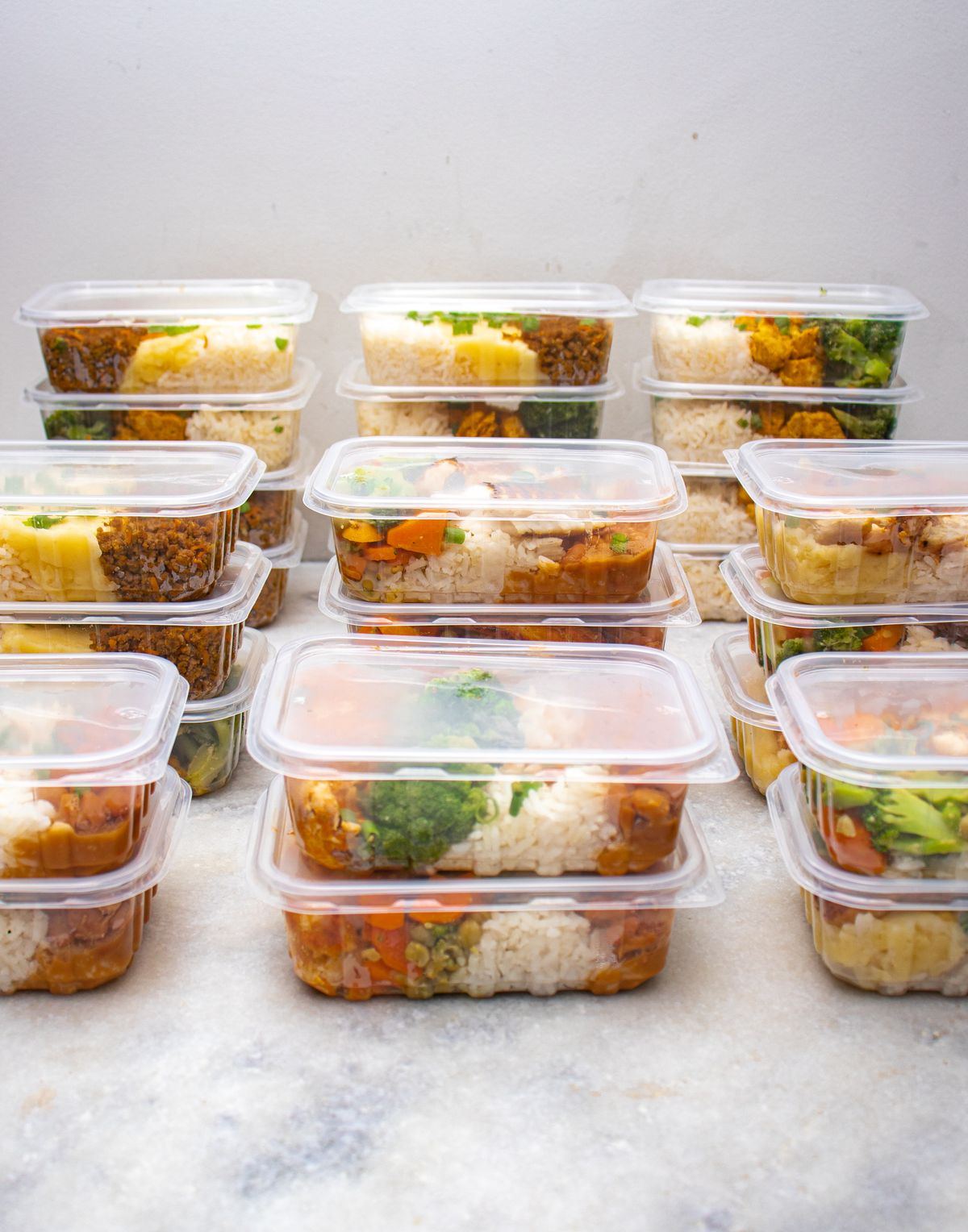
The rule is simple and it is the one most people get wrong: store components, never assembled bowls. An assembled bowl in the fridge turns to mush, because the salsa and the lettuce leak into the rice.
| Component | Fridge | Freezer | Reheat? |
|---|---|---|---|
| Protein | 4 days | 3 months | Yes |
| Rice | 4 days | 3 months | Yes |
| Beans | 4 days | 3 months | Yes |
| Corn salsa | 4 days | No | No – serve cold |
| Fresh tomato salsa | 2 days | No | No – serve cold |
| Cheese, soured cream, lettuce | To the pack date | No | No |
| Guacamole | 1 day | No | No |
| An assembled bowl | Do not | Do not | — |
The working method for a week:
- Sunday: make protein, rice and beans. Portion them into five containers, 4 oz of each.
- Also Sunday: make the corn salsa, which holds four days. Keep it in one tub, not portioned.
- Each day: microwave the rice, beans and protein together, 60 to 90 seconds, with a teaspoon of water.
- Then add the cold things — salsa, cheese, soured cream, lettuce — after reheating, never before.
- Guacamole only on the day you make it. Two avocados takes ten minutes.
That reheat-hot-then-add-cold sequence is exactly how a restaurant bowl is built, and it is why a prepped bowl done this way tastes close to a fresh one while an assembled-and-refrigerated one does not.
Three Builds Worth Copying
The high-protein build — 64g before extras
Double chicken, brown rice, black beans, fresh tomato salsa, fajita vegetables, no soured cream. Chicken carries 32g of protein per 4 oz, the most of any Chipotle protein, so two scoops gives 64g before the rice, beans and cheese add roughly another 18. Our highest-protein guide goes further.
The vegan build — and the guacamole is free
Sofritas, rice, beans, all the salsas, lettuce and guacamole. Chipotle allergen page confirms its sofritas is vegan and vegetarian approved and that its rice, beans, salsas, tortillas, chips and guacamole are all vegan too. And guacamole is included at no charge on veggie and sofritas builds at Chipotle — the one case where it costs nothing. Our sofritas recipe has the build.
The lowest-sodium build
Steak, brown rice, no-salt-added beans, fajita vegetables, romaine, guacamole, no cheese and no soured cream. Brown rice saves 160mg over white, romaine is the only item on the menu at zero sodium, and skipping both salsas avoids the 550mg in the fresh tomato. Made with our recipes at half salt, it comes in under 800mg.
Every component recipe is indexed on our copycat recipes page. If you would rather order it, our best bowl combinations and build your own guide cover the counter version.
Frequently Asked Questions
What do you need to make a Chipotle bowl at home?
Five cooked components and four shop-bought ones. You need cilantro-lime rice, beans, a protein, at least one salsa and guacamole — each of which has its own recipe — plus grated Monterey Jack, soured cream, shredded romaine and lime wedges. Make the adobo paste first if you are doing chicken, steak or sofritas, because all three are built on it.
What are Chipotle’s actual portion sizes?
Chipotle publishes them in its nutrition data: 4 oz of rice, 4 oz of beans, 4 oz of protein, 4 oz of the chunky salsas and 2 fl oz of the tomatillo ones, 1 oz of cheese, 2 oz of soured cream, 4 oz of guacamole and 1 oz of romaine. Weighing them once tells you what a restaurant scoop looks like, and after that you can eyeball it.
What order does Chipotle build a bowl in?
Rice goes in first, then beans, then the protein, then salsas, then cheese and soured cream, then lettuce, then guacamole on top. That order follows the line layout and it is also structurally sensible: the rice absorbs the juice from everything above it, the dairy sits where the heat of the protein can soften it, and the guacamole stays on top where it does not get warm.
Is making a Chipotle bowl at home cheaper?
Yes, and the useful way to see it is by the batch. One cooking session of all the components makes about six bowls. At the price a chicken bowl typically runs, six bowls at Chipotle comes to roughly $64.50 — so whatever your shopping for those six bowls costs is the comparison. The gap is large, but the fair accounting includes the two to three hours of cooking.
Are homemade Chipotle bowls healthier?
On sodium, substantially — a like-for-like homemade bowl works out around 680mg lower than the restaurant equivalent, mostly because you control the salt in the rice, the salsa and the protein. On calories and protein they come out close. The restaurant bowl is not unhealthy so much as salty: a chicken bowl with rice, beans, both salsas, cheese and soured cream comes to nearly 2,000mg of sodium.
How long do the components keep?
Protein, rice and beans keep four days refrigerated and freeze for three months. The chunky salsas keep two to four days — fresh tomato is best the same day, corn salsa holds longest. Guacamole is a one-day component, so make it the day you eat it. Never freeze salsa or guacamole, and never store an assembled bowl.
Can you meal prep Chipotle bowls?
Yes, but store the parts and not the bowls. Portion rice, beans and protein into containers, and keep salsa, cheese, soured cream, lettuce and guacamole separate to add when you eat. Reheat only the rice, beans and protein — sixty to ninety seconds with a splash of water — then add the cold components. An assembled and refrigerated bowl goes soggy, because the salsa and the lettuce leak into the rice.
How do you make a high-protein Chipotle bowl at home?
Double the chicken. Chicken carries 32 grams of protein per 4 oz, the most of any Chipotle protein, so two scoops gives you 64 grams before anything else — and the rice, beans and cheese add roughly another 18. Skipping the soured cream and taking fajita vegetables instead keeps the calories down. Doubling protein is also the one upcharge at Chipotle that is arguably good value.
Methodology
Portion weights on this page are taken from the serving sizes Chipotle publishes alongside each item in its US nutrition facts menu, and all restaurant calorie, sodium and protein figures come from that same document. The bowl comparisons are built by adding Chipotle own per-item figures rather than estimated, and the totals are checked against the entree ranges Chipotle publishes for its bowls. Chipotle states that nutritional content varies with portion size, recipe, growing season and ingredient source, and that serving sizes are approximations based on how items are usually prepared. Homemade figures are calculated estimates from our own component recipes. The price used for the comparison is the figure this site tracks for a chicken bowl and varies by location.